As an Amazon Associate we earn from qualifying purchases. Links marked ↗ go to Amazon UK searches; buying through them costs you nothing extra. How this site is funded.
Home Emergency Kit is an independent guide. It is not affiliated with, or endorsed by, the UK government or the Be Ready campaign.
Run by IIB Trading Ltd · [email protected]
What a UK emergency usually looks like
The government's Be Ready hazards pages cover things like power cuts, flooding, storms, snow and ice, and disruption to water or transport. For most of these, the advice is to stay at home: Be Ready describes the approach as “Go in, Stay in and Tune in” to local or national radio unless there's an obvious risk to the building. Sometimes people are asked to leave, and then you follow the emergency services and take a grab bag.
Where you live matters. Ready Scotland points out that rural areas are more likely to be cut off from the shops during snow, and people in flood-risk areas may want to be ready to leave at short notice. That's a good reason to tailor your kit, but not to triple it.
What you actually need
Strip away the marketing and a UK survival kit comes down to eight things, all taken from the official Be Ready checklist:
Bottled, 3 litres per person per day for drinking, plus extra for cooking and washing.
Tins and snacks that need no fridge and no cooking.
A torch and spare batteries. No candles needed.
Blankets, sleeping bags and warm layers for when the heating stops.
An FM radio that runs on batteries or a wind-up handle.
A power bank kept charged for phones and compatible medical devices.
Coins and notes, copies of ID and documents, numbers written down.
First aid items and enough of your regular medication.
Add baby supplies, pet food and anything particular to the people you live with. That's the whole list. Our full home emergency kit checklist goes through each item with notes on what to buy.
What you can probably skip
Online survival lists often include gear that the official advice never mentions. Some of it is just expensive; a few items are a real safety risk indoors.
- Months of freeze-dried rations. Be Ready asks for 3 days of food and says it's best to buy food you'd usually eat. Food you eat anyway gets rotated and doesn't go to waste.
- Candles as your main light. The checklist says torches are safer than candles.
- Using a barbecue, camping stove or generator indoors. The NHS warns that using barbecues or camping stoves inside can cause a build-up of carbon monoxide, and lists portable generators among the appliances that can produce it. If you own one, keep it out of the house and away from enclosed spaces.
- Water filters in place of stored water. The official list asks for bottled water, so store that first; filters aren't on it.
- Knives, axes and “tactical” kit. Neither the Be Ready nor the Ready Scotland kit list calls for them.
- Gas masks and radiation gear. Again, not on either official household list.
Cheaper, safer swaps
| Instead of | Try | Why |
|---|---|---|
| Freeze-dried survival meals | Ring-pull tins, crackers, dried fruit and nuts you already buy | No cooking, no fridge, and you'll actually eat them before they expire |
| Candles and lanterns with flames | A head torch and an LED lantern | Safer, and a head torch leaves your hands free |
| A petrol generator | A charged power bank and a wind-up radio | Keeps a phone and the news going with no fumes |
| A pricey “72-hour” bucket kit | A lidded crate filled from the official checklist | You choose what goes in, and skip what you already own |
| Thermal “survival” suits | Sleeping bags, duvets, hats and thin layers | The cold-weather advice is several thin layers rather than one thick one |
Search Amazon UK: Head torches LED lanterns Wind-up radios with USB
Are ready-made survival kits worth it?
A ready-made kit can be a convenient start, especially for a first aid kit or a bag of small items. Before you buy one, check its contents list against the checklist. No shop kit can include your medication, your documents, your phone numbers or the food your family eats, and those matter most. Look for a kit that lists every item, gives dates for any food or water in it, and doesn't charge you for things you already own.
Search Amazon UK: Ready-made emergency kits First aid kits
Enter the adults, children, babies and pets in your home and get water and food totals based on the official 3 litres a day.
Build it around the people in your home
The parts of a kit that make the most difference are the personal ones. Think about:
- Babies: ready-to-feed formula, because you may not be able to boil water, plus nappies and wipes.
- Regular medicines: order repeat prescriptions up to 5 working days ahead, as Be Ready advises, so you're not caught short.
- Disability or health needs: spare glasses, hearing aid batteries, mobility aids and chargers for equipment. Be Ready has advice for disabled people and carers.
- Older or isolated relatives and neighbours: agree who will check on them, in person if phones are down.
- Pets: food and bottled water for them too.
A small kit for the car
For winter journeys, Be Ready suggests keeping a torch, an in-car phone charger, warm clothes and blankets, high-visibility clothing, jump leads, food and drink and a snow shovel in the boot, and says a first aid kit is helpful too. It's a sensible, compact kit and much more likely to be used than a bunker's worth of supplies.
Questions people ask
Do I need a survival kit in the UK?
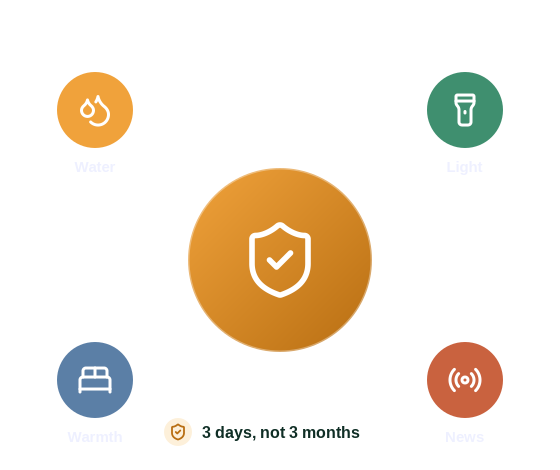
The UK government's Be Ready campaign recommends that households keep enough essentials to manage for 3 days. Most people already own much of it. You don't need specialist survival gear.
What is the difference between a survival kit and an emergency kit?
In a UK home they're the same idea. 'Survival kit' tends to suggest outdoor or prepper gear, while official advice talks about a home emergency kit of everyday supplies.
How long should a survival kit last?
The official Be Ready checklist is built around 3 days. You can store more if you like, but 3 days is the recommended starting point.
Is a generator a good idea for emergencies?
It isn't on the official checklist. The NHS lists portable generators among appliances that can produce carbon monoxide, so one must never be run indoors or in an enclosed space. A charged power bank covers phones for most households.
Are ready-made survival kits worth buying?
They can be a useful start, but check the contents against the official list. No ready-made kit includes your medication, documents or the food your household eats.
Do I need water purification tablets?
The official checklist asks for bottled water: 3 litres per person per day for drinking for 3 days, plus extra for cooking and washing. Store that first.
Related guides
Sources
- Be Ready: Be informed about hazards
- Be Ready checklist (PDF, October 2026)
- Be Ready: Be ready for emergencies (UK government campaign)
- Ready Scotland: Make an emergency kit
- NHS: Carbon monoxide poisoning
- Be Ready: Advice for disabled persons and carers
Official pages last checked on 23 November 2026. If anything here differs from the official advice, follow the official advice, and please tell us so we can fix it.